


What do applications of Elias’ social theory contribute to the study of childhood and children? The volume International Comparisons in Learning and Education. Eliasian Perspectives provides an aswer. The book is edited by Norman Gabriel and is published in the series, Palgrave Studies on Norbert Elias. Seventeen scholars from all over the world, all of them inspired by Elias’ paradigm, write about their research on children, adolescents and young adults. The volume is loosely arranged into three parts – I Early years, education and schooling; II Informalization processes and social inequalities; III Intergenerational processes: new forms of interdependencies.
Apart from an interest in children, the common thread running through all the contributions is an engagement of some sort with Elias’s approach to sociology, across a wide variety of topics. Within the frame of a short review it is impossible to do justice to this variety, so I only can give an impression of the broad range of the volume. It stretches from the shifting informalising/formalising trends of parent-child relationships in Western developed countries, as reflected in children’s play (Sánchez-García: 109-131), to insider-outsider figurations in a democratic health promotion project in a secondary school in Denmark (Frydendal and Friis Thing :221-247). It involves the explanation of processes of generational transmission of ‘nationalism’ (Delmotte and Duchesne, France: 81-106) and the study of power dynamics of shame and changes in child centering in the 18th and 19th century in Germany (Waterstradt 179-201).
What, then, does an Eliasian approach add to the existing childhood research? It is only a few decades ago that sociologists studied children exclusively within a context of families and education. The socialization of children, how they were becoming adults, that was seen as an issue of sociological interest. That perspective was however broadened in the 1980s when the acting and interacting of children, just like their wishes and their troubles, also became legitimate issues in the sociology of childhood and children. In many contemporary studies of childhood sociologists attribute agency to children, sometimes giving children an unwarrantedly active role in the construction of their own worlds. According to the contributors to this book, such social constructionism doesn’t move beyond the dichotomized oppositions of agency and structure, while the Eliasian paradigm makes it possible to overcome this seeming polarity. The authors of several chapters demonstrate how all children are growing up and interacting within webs of broader interdependencies, spatially and institutionally. Interactions in the classroom and between peers are embedded in broader figurations of parents, teachers, schools and policymakers. (Gilliam and Gulløv, Denmark: 53-81; Röhrich Ferreira, Brazil: 201- 221).
The balances of power are constantly shifting within these networks of children, different educators and the state. As schooling becomes universal and children are socialized in more different pedagogical regimes, institutes like day care, pre-school and school have acquired more relevance, at the expense of parental influence. These institutions of care and education are legally regulated, offering schools the legitimacy to determine rules, routines and practices (Sarat et al., Brazil: 35-53). The expansion of compulsory education imposed by the state can be understood as the monopolization of the time, workforce and minds of children, reminding one of the stately monopolization of tax and violence. This view on shifts in power balances demonstrates the value of using a long-term perspective. The authors perceive a standardisation of socialisation and education as one of its consequences (Gilliam and Gulløv, Denmark: 53-81).
Pedagogical institutions thus attained pivotal positions in processes of civilisation and habitus formation, connecting the private realm of childhood and family life to the administration of the state. It is in schoolclasses that new manners are formed, and that behaviour standards are negotiated with the young on a daily basis. It is there that children and teachers discuss and transform relations, conduct and status, thus shaping children’s habitus. In schoolclasses children learn about what is valued and how to behave, they gain an understanding of hierarchies and prestige, and these processes can be compared to those constituting social relations in court society as Elias analysed them. Take, for example, the operation of banter at school. Banter is a complex style of communication, which balances formality with informality. It presupposes a high level of identification and respect, as is demonstrated in secondary-school setting in England in the 21st century The use of banter is one of the examples which can illustrate the high level of communication young people have to acquire on their way to adulthood. (Gilliam and Gulløv, Denmark: 53-81; ; Sánchez-García: 109-131; Mierzwinski and Velija, England: 131-155).
The editor of the volume, Norman Gabriel, focuses on another contribution of the Eliasian paradigm. Elias highlights the connection between the dynamics of social relations and habitus formation, which means that research into children’s acting should incorporate unconscious, affect-laden, non-linguistic processes. Gabriel agrees, but he wants to go further by drawing on conceptualisations from the work of psychoanalysts, suggesting the integration of concepts and ideas of, in particular, Anna Freud, Donald Winnicott and Wilhelm Reich (Gabriel 2024: 11-35).
This edited collection constitutes an interesting assortment of applications of Elias’ social theory to issues surrounding childhood, but it could have benefited from more general reflection, regarding, for example, the origin and the choice of the contributions, the similarity and differences between the various accounts, as well as the tensions and dilemma’s in the study of childhood from the perspective of figurationalist sociology. Especially useful in this respect would be the concept of ‘the civilising paradox’, as introduced by Gilliam and Guløw in an earlier publication – Children of the Welfare State (2017), only mentioned briefly here: ‘…that the socialising efforts designed to civilise also have excluding effects which might again enhance the strategic use of “uncivilised” conduct by those who feel outsiders to “‘the civilised community”’. If one sees childhood studies as a specific case of a civilisation offensive, this observation is not only relevant for childhood studies. It addresses both sides of broader civilising processes, encompassing both mechanisms of excluson as well as inclusion.
Norman Gabriel (ed.) 2024, International Comparisons in Learning and Education. Eliasian Perspectives. Palgrave Studies on Norbert Elias.
Laura Gilliam and Eva Gulløv 2017, Children of the Welfare State. Civilising Practices in Schools, Childcare and Families. London: Pluto Press.
https://norbert-elias.com/wp-content/uploads/2025/02/Figurations_62.pdf: Elias, childhood and children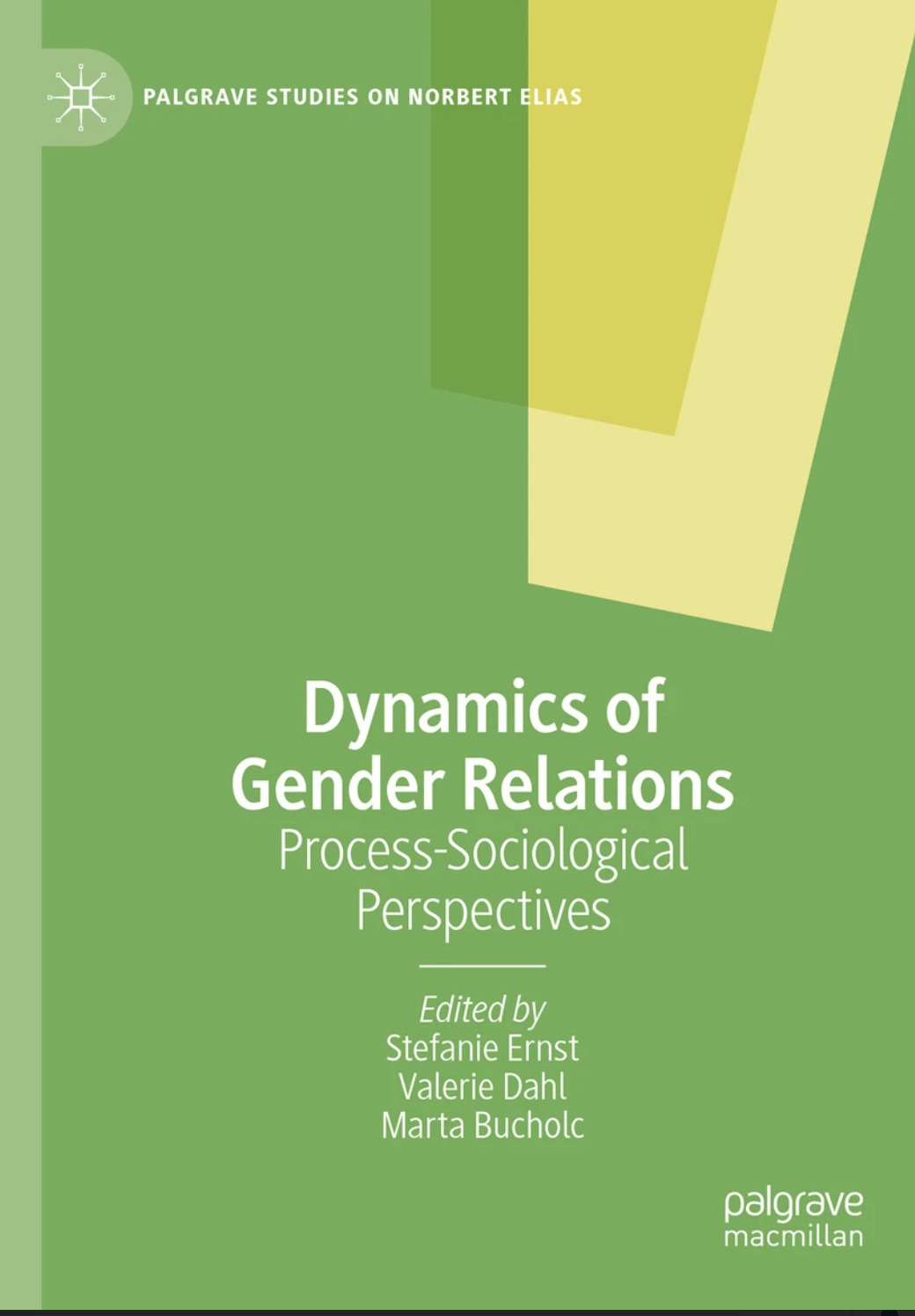
Een qua opzet vergelijkbare bundel in dezelfde serie, maar ditmaal over gender, is Dynamics of Gender Relations onder redactie van Stefanie Ernst, Valerie Dahl, Marta Bucholc, uitgekomen in Mei 2025 als onderdeel van Palgrave Studies on Norbert Elias.. De 21 hoofdstukken zijn even gevarieerd als die over kinderstudies, qua onderwerp, plaats en tijd. Een paar voorbeelden kunnen de breedte illustreren: Informalisering en de emancipatie van lust en liefde van Cas Wouters, Franse adviesliteratuur voor moeders van Emma Tillich, de dynamiek van gender in academia van Valerie Dahl, mannelijkheid op het Poolse platteland van Jochen Kibel en anderen; debatten over seksuele initimidatie in een Pools tijdschrift van Pawel Baginsky, over misogynie en gewelddadigheid van Michael Dunning en anderen.
In een introductie op het boek schrijven de auteurs het volgende:
‘About this book
This edited volume brings together for the first time international research approaches from the field of figurational and processual sociology at the intersection of gender studies. It assembles current research on the change of gender relations in formal and informal structures. By using Norbert Elias’s process-sociological oeuvre selected gender figurations in the western and non-western world are discussed. This book is anchored, on the one hand, in a socio-historical understanding of the trajectory of gendered societies over a wide area and range of centuries in the Process of Civilization. On the other hand, the immediate impulse for this volume is the critical discussion of Eliasian thinking concerning dynamic gender relations in different empirical case studies and process-theory. It will be crucial reading for sociologists interested in the Elias school, as well as sociologists of gender more broadly.’
Christien Brinkgreve en ik schreven een hoofdstuk met als titel ‘Some Reflections on the Emancipation of Women. How Far Did We Come?’.
Hier volgt de Abstract:
Concerning the emancipation of women, the question ‘how far did we come?’ is difficult to answer. The gender domain has changed and is continuously changing, the field has become more complicated and more ambiguous. The social inequality between men and women has diminished, old patterns of male dominance are gradually losing their grip. Ambivalences and dilemma’s became a steady ingredient of the inner life of women – and men. In the Netherlands planning and policy evolved into an unilinear direction: mothers should enter the labor market. But the feminist debate covered more ambiguity and a larger range of controversial themes than paid labor and part-time or full-time employment.
As Norbert Elias observed, a decrease of power differences goes together with diminishing contrasts in conduct and emotions. But more equality gave also more room to variation. The conceptions of masculinity and femininity were changing, and the scope of the debate about gender and gender identity became broader: The emancipation of people with other sexual orientations became included, homosexuals, transgenders, non-binary people.
The progression in the emancipation of women induced a backlash among men and more awareness and more concern of the weakened position of men, of their worries and their insecurity. But apart from the conservative backlash from outside, women are also hindered by internalized patterns of subordination.
Changes in power relations are multi-level processes: the political, social and psychological field are intertwined and do not change simultaneously. Progress in the public domain goes together with emotional strains and ambivalences in the domain of intimate relations. The old ideals and practices of male supremacy and female subordination have not disappeared. This generates tension and conflict, not only among individuals, but also within them – a new and important topic in the field of gender studies.
 Kundig in het midden